Problem Solving - The Clothes Maiden

When you hear the phrase “problem solving” you probably assume that there is something wrong that needs a resolution. Whilst that is certainly a correct assumption, the phrase means much more than that. We all problem solve at different levels throughout our daily lives. From deciding what to wear, to what to eat, we all make decisions in our day so routinely that we don’t even consider them to be problem solving. For people with ASD these simple task can be quite a challenge.

I have no dress sense, so I own about 30 black t-shirts, because that’s easy. I buy the same shoes over and over because it’s easier than deciding if a new style suits. I’m not even sure the style that I have suits! I buy the same socks and underwear in bulk too. Basically I dress all in black!

There is one particular thing that I do which really wound Maria up and was the cause of more than one argument, and that is how I unload the washing machine and arrange the clothes on the clothes maiden.

Maria has the ability to just pull items out of the washing machine and place them in random places on the maiden, as though solving a Krypton Factor puzzle, and have the task complete within a few minutes. It would take me at least 15 minutes to do.

First I have to get all of the items out of the machine and categorise them into socks, underwear, trousers, tops along the work surface in the utility room. I then put the socks at the bottom of the maiden, underwear next, then tops and finally trousers. There is just no way that I can randomly pull items out and place them in the correct order on the maiden. If I start at the top, or place things randomly, then the items get in the way of placing the lower ones.

This would really frustrate and annoy Maria because no matter how many times she tried to “train” me to do it her way, I just couldn’t get it. She would think that I was wilfully doing it my way to annoy her, but I wasn’t. There is just no way that I can complete this task in any way other than how I do.

Consequently this leads to an increase in anxiety, because you start to think that you are stupid for not being able to do something that is so simple for others.
"You're Intelligent, Work It Out"

Throughout my life the phrases “You’re not stupid, work it out” , “You’re an intelligent guy, work it out”, “You have no common sense” or variants there-of seem to have been directed at me constantly from all directions. At work, at play, at home. But mostly at home in personal relationships.

Both Maria, and her successor Nathalie, were very fond of this phrase.

It’s mostly used during disagreements and I’ve come to recognise it now as a clue that I’ve done something wrong, and it makes me feel really stupid. It also frustrates, as the person saying it will often then tell me that I’m playing games.

I don’t play games. Life is hard enough trying to decipher other people; game playing makes it even harder.

Yes I am a very intelligent guy, but I do lack common sense and sometimes I really don’t understand what is going on in a conversation, or what it is that I’ve done or said that is wrong, and that I need to “work out”.

But “common sense” has nothing to do with intelligence.

I have difficulties with communication, social understanding and judgement. I miss cues, make inappropriate comments, and cross boundaries. These are all part of “common sense”.

The people in my life, friends, family and colleagues all know of my condition, so I guess that I have the expectation that they will give me some leeway and explain to me what it is that I’ve done, rather than expecting me to “work it out”, because if I do “work it out” the chance is that I’ll still get it wrong.

But I guess that the neurotypicals have their off days too, and it must be frustrating to have to deal with me.

But it hurts on two levels when it’s your partner saying it because of all people you expect them to have the most understanding, but you also know that you’ve upset or frustrated them, and that makes the anxiety levels go through the roof. There must be a finite number of times their patience will run low before they decide to leave.

Introduction - Part One

As I’ve mentioned elsewhere, I wasn’t diagnosed until I was 40. I think that the diagnosis came so late on in life because of how I was brought up. Events in my childhood could easily explain away my autistic traits. So I thought I’d talk about my life to date over the next few posts to give some context.

I was bought up in the mid 70s in a two bedroom terrace in a small village in an industrial area of North Staffordshire. My home situation was not normal. I was an only child, and my mum wasn’t married, which wasn’t that common back in the 70s. We lived in what had been her family home with my two uncles, until I was 15. My two uncles shared one room, and I had to share a room with my mum. When you’re 15 and sharing a room with your mum, and your two uncles share a double bed, you’re not that inclined to ask friends over. It’s embarassing. Consequently you don’t really make any friends.

I was bullied at school because my mum was not married. So again, no scope for making friends.

Although there were other kids in the village, I tended to be a bit of a loner. They all had father figures who would take them to football etc and I had no-one. So they were into football and played it all the time, and I had no interest or aptitude for it. As we lived right next to the West Coast Mainline I took up trainspotting, as you don’t need friends to do that.

I was very much tied to my mums apron strings. I was a very shy child and she would do everything for me and would not push me outside my comfort zone, so when I was invited to do things with others, I’d often decline to do so, as I was shy.

When I turned 11 I won a scholarship to the local independant school on the merits of my intelligence. I was surrounded by kids from well off backgrounds, whilst I got free school uniform and free school meals, which was obvious to the other kids. They all lived in modern houses, I lived in a 100 year old terrace with my mum and two uncles. So I was picked on for being poor. The kids in the village didn’t want anything to do with me because they were influenced by their parents who were jealous of me going to a private school.

I was also picked on because of my high forehead, and my facial ticks, which I now think are actually autistic stims.

So I had no friends. I indulged myself in my hobbies, which were going out on bike rides by myself, train spotting, electronics and chemistry sets, and computer programming. One of my uncles bought a BBC Micro when I was 10, so I would spend hours learning how to programme it whilst I could see the kids from the village playing out.

The school that I went to was an all boys school, so I didn’t have exposure to girls during my pubescent and teen years, and that coupled with my home circumstances meant I never learned how to chat someone up. To this day I have never asked a woman out; I’ve always been the one to be asked. I still don’t have a clue how to do it, what to say.

I guess that I’ve always put my chronic shyness and inability to socialise down to my nurturing because I didn’t have the practice and experience in my formative years due to my home circumstances, rather than it being down to my Aspergers.

Autistic Burnout

I was just browsing Gavin Bollard’s excellent “Life With Asperger’s” blog and came across the concept of “Autistic Burnout” for the first time. It’s not something that I’d heard of before; it’s certainly not mentioned on any of the more “technical” sites, such as the National Autistic Society, or in the many books that I’ve read.

For the past 6 weeks I’ve barely been able to function. I feel like I’ve been on autopilot. Typically I just get up at 0500, go to work, get home at 1930, eat, go to bed and repeat. Everything else, such as doing housework, or attending the youth group that I’m involved with, has been a struggle. Weekends are worse; I just stay in bed as long as I can just to avoid facing the world, which is something I’ve never done in my life.

I feel broken.

I thought that I was depressed, because the last 6 months have been one hell of an emotional rollercoaster. I came out of a relationship of 7 years and somehow ended up in a new, very intense one straight away, which itself came to a very abrupt and unexpected end at the start of March.

Now I’m thinking that I’m suffering from autistic burnout rather than being depressed, although from my brief readings so far I’m not sure that there are too many differences in the causes and symptoms.

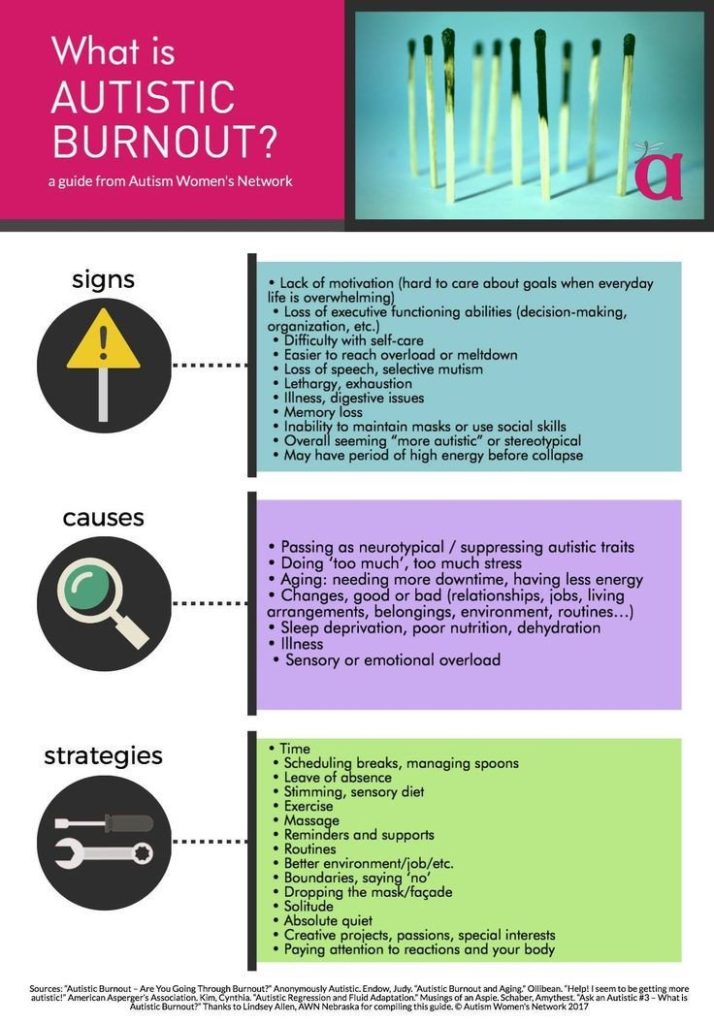
In summary Autistic Burnout is an accumulation of years of trying to appear normal and cope as an Neurotypical (NT). The strain and drain of it suddenly becomes too much and an autistic person (me in this case) falls apart. All autistic symptoms get worse. Trying to manage all the everyday normal activities are way too much. It is overwhelming and stressful for the person involved.

Kezza - What is Autistic Burnout

For the first time in a very long time I don’t have to go home and put on a façade, because there is no one else there. But I also don’t have the energy to put on a façade at work, or anywhere else for that matter, so I’ve reverted to being very blunt/abrupt with people. Gone are the acts that I’ve developed over the years.

I don’t think I realised just how hard I try to fit in to the Neurotypical World, and how exhausting it is to do so. Everything I do to try to live a “normal” life goes against my instincts.

Now I have no relationship the stress of trying to maintain a relationship has gone, and boy was that stressful. Trying to understand your partner’s needs, and what they are telling you, and constantly getting it wrong puts your anxiety right up at 100% 24/7.

Not having a partner also means that I don’t have a social life anymore, as all of “my” friends were actually hers. So I no longer have to make an effort there either, not that I ever really did. Over the years we did less and less socialising because of how I always embarrassed her.

So for the first time in 8 years I have no reason to make the effort, and I think that the stresses of all the acting that I’ve had to do have caught up with me, and I’ve crashed.

I love my job. I’ve always loved working. For the past 23 years I’ve been used to getting up between 4 and 5, and being out of the house for 12 to 14 hours. Right now I really can’t be bothered. The 55 mile commute has suddenly become a drag, and I have no interest in work when I’m there. I’d rather just stay at home, but not having a job would make my life even worse.

I certainly am experiencing many of the signs in the infographic above, and can tick the box against many of the causes.

I just haven’t figured out a strategy yet to get myself out of this. I don’t know how to motivate myself right now. All that I want to do is just curl up in a ball in a corner somewhere and have the world pass me by.